

As the new financial year begins, understanding the tax-free income limit from April 1, 2026 becomes essential for effective tax planning. With the introduction of the Income-tax Act, 2025, the overall structure of taxation has been simplified. However, despite structural changes, tax slabs, rebate limits, and exemption thresholds remain largely unchanged, which directly impacts how much income is tax-free.
This article explains the tax-free income limit from April 1, 2026 under both the old and new tax regimes, helping taxpayers determine which option is more beneficial.
Tax-Free Income Under the Old Tax Regime
Under the old tax regime, the tax-free income limit from April 1, 2026 continues to depend on both the basic exemption limit and the rebate under Section 87A.
The basic exemption limits are:
-
₹2.5 lakh for individuals
-
₹3 lakh for senior citizens
-
₹5 lakh for super senior citizens
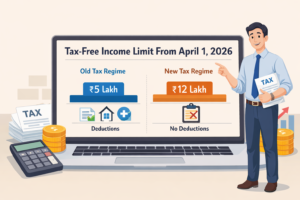
However, due to the Section 87A rebate of ₹12,500, individuals with total income up to ₹5 lakh effectively pay zero tax. This means the practical tax-free income limit from April 1, 2026 under the old regime is ₹5 lakh.
Additionally, taxpayers can further reduce taxable income through deductions such as standard deduction, Section 80C investments, housing loan interest, and health insurance premiums. If the taxable income after deductions remains within ₹5 lakh, no tax is payable.
Can Income Above ₹5 Lakh Be Tax-Free?
Yes, under the old regime, the tax-free income limit from April 1, 2026 can effectively extend beyond ₹5 lakh if deductions and exemptions are fully utilised.
Common deductions include:
-
₹50,000 standard deduction for salaried individuals
-
Up to ₹1.5 lakh under Section 80C
-
Up to ₹2 lakh for home loan interest
-
Section 80D for medical insurance
-
House Rent Allowance (HRA)
By strategically using these deductions, taxpayers with higher gross income can still bring their taxable income within the rebate threshold, thereby maintaining zero tax liability.
Tax-Free Income Under the New Tax Regime
The tax-free income limit from April 1, 2026 is significantly higher under the new tax regime due to an increased rebate.
The key highlights are:
-
Basic exemption limit: ₹4 lakh
-
Rebate under Section 87A: ₹60,000
-
Effective tax-free income limit: ₹12 lakh
For salaried individuals, the benefit increases further. With a standard deduction of ₹75,000, the tax-free income limit from April 1, 2026 effectively rises to ₹12.75 lakh, provided taxable income remains within ₹12 lakh after deduction.
This makes the new regime highly attractive for individuals who do not claim multiple deductions.
When Tax Applies in the New Regime
Despite the higher tax-free income limit from April 1, 2026, tax liability arises in certain cases:
-
When taxable income exceeds ₹12 lakh
-
When income includes special-rate components like capital gains
Capital gains from equities and mutual funds are taxed separately and do not qualify for rebate under Section 87A, even if total income is below the threshold. This is a crucial consideration while evaluating the tax-free income limit from April 1, 2026.
Old vs New Tax Regime: Key Comparison
The comparison highlights how the tax-free income limit from April 1, 2026 differs across regimes:
-
Old Regime: ₹5 lakh (extendable with deductions)
-
New Regime: ₹12 lakh (₹12.75 lakh for salaried individuals)
-
Deductions: Available in old regime, limited in new regime
-
Suitability: Old regime for high deductions, new regime for simplicity
The tax-free income limit from April 1, 2026 clearly favours the new tax regime for most taxpayers due to its higher rebate and simplified structure. However, the old regime still offers advantages for individuals who actively utilise deductions and exemptions.
Choosing the right regime depends on income composition, investment habits, and eligibility for deductions. A careful comparison is essential to maximise tax savings under the tax-free income limit from April 1, 2026.
 Want to understand how to avoid refund delays in the future? Receive our expert guidance on accurate tax filing and faster refund processing – Click here.