

The Penalty for 2-Day MGT-15 Filing Delay has become a growing concern for companies striving to maintain strict statutory compliance under the Companies Act, 2013. Regulatory authorities have increasingly adopted a zero-tolerance approach toward delayed filings, emphasising that even minimal non-compliance can trigger significant financial consequences. This development highlights the importance of timely compliance, irrespective of the duration of delay or operational challenges faced by companies.
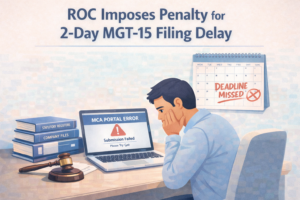
Understanding MGT-15 Filing Requirements
Form MGT-15 is a mandatory filing requirement for companies following certain corporate actions involving share capital or securities. The purpose of this form is to ensure transparency and accurate reporting of corporate events to the Registrar of Companies (ROC). Filing within the prescribed timeline is not optional but a statutory obligation.
A Penalty for 2-Day MGT-15 Filing Delay arises the moment the filing crosses the statutory due date. The Companies Act does not distinguish between a short delay and a prolonged default; any delay is treated as a violation of law.
Why Even a Two-Day Delay Matters
Many companies assume that a short delay, such as two days, may be condoned due to its negligible impact. However, regulatory practice demonstrates otherwise. The Penalty for 2-Day MGT-15 Filing Delay reflects the strict interpretation of compliance timelines, reinforcing that statutory deadlines are absolute unless formally extended by the Ministry of Corporate Affairs (MCA).
This approach is rooted in the principle of regulatory discipline. Allowing leniency for short delays could undermine the compliance framework and encourage a culture of casual filing.
Impact of MCA Portal Challenges
Technical issues on the MCA portal have often been cited as a reason for delayed filings. While system glitches, slow response times, and validation errors are practical challenges, they do not automatically exempt a company from liability. Unless the MCA officially grants an extension or issues a relaxation notification, the statutory obligation remains unchanged.
As a result, the Penalty for 2-Day MGT-15 Filing Delay may still be imposed despite genuine technical difficulties. Companies are therefore expected to plan filings well in advance and maintain documentary evidence of any system-related issues faced during submission.
Liability of Company and Officers
An important aspect of the Penalty for 2-Day MGT-15 Filing Delay is that accountability is not limited to the company alone. Directors, key managerial personnel, and officers responsible for compliance may also be subject to personal penalties. This reflects the legal position that compliance is a governance responsibility and not merely an administrative task.
Personal liability serves as a strong deterrent and encourages senior management to actively oversee statutory filings rather than delegating them without adequate supervision.
To avoid exposure to a Penalty for 2-Day MGT-15 Filing Delay, companies should adopt the best practices.
Broader Compliance Implications
The imposition of a Penalty for 2-Day MGT-15 Filing Delay signals a broader regulatory trend toward strict enforcement of procedural requirements. It reflects the regulator’s intent to promote discipline, transparency, and accountability in corporate governance. Companies can no longer rely on the assumption that minor delays will be ignored.
This strict stance also aligns with global best practices, where regulatory certainty and adherence to timelines are considered essential for maintaining investor confidence and market integrity.
The Penalty for 2-Day MGT-15 Filing Delay serves as a clear reminder that compliance timelines under the Companies Act, 2013 must be treated as sacrosanct. Even brief delays can result in financial penalties and personal liability for officers in default. In an increasingly digitised compliance environment, proactive planning, early filing, and strong governance mechanisms are essential to avoid regulatory exposure. Companies that prioritise compliance discipline are better positioned to mitigate risk and maintain long-term regulatory credibility.
 To learn more about ROC Annual filing & Company Compliance get expert help – Click here