

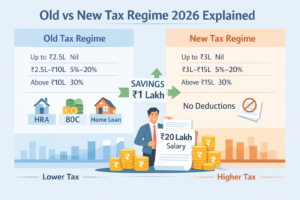
The debate around the old vs new tax regime 2026 has become increasingly relevant, especially after the government’s updated draft tax rules effective from April 1, 2026. For salaried individuals earning around ₹20 lakh annually, the choice Old vs New Tax Regime 2026 is no longer straightforward. The difference between the two regimes Old vs New Tax Regime 2026 can lead to tax savings of over ₹1 lakh, making it essential to evaluate both options carefully.
While the new tax regime offers simplicity with lower slab rates and minimal compliance, the old tax regime continues to reward disciplined financial behavior through deductions and exemptions. This shift indicates that taxpayers must now align their tax strategy with their financial habits rather than simply opting for lower tax rates.
Why Old vs New Tax Regime 2026 Matters for Salaried Individuals
Over the past few years, many taxpayers shifted to the new regime due to its ease of use and reduced paperwork. However, the 2026 tax framework has brought the old tax regime benefits back into focus. The revised rules clarify deductions and enhance certain exemptions, making the old regime more attractive for individuals who actively invest, pay rent, or manage home loans.
Increased allowances such as higher meal reimbursements, enhanced gift exemptions, and additional employer-related benefits can significantly reduce taxable income. These changes highlight that the Income tax is not phasing out the old regime but rather strengthening it to remain competitive alongside the simplified new regime.
Tax Savings Example: ₹20 Lakh Salary Comparison
To understand the real impact of the new tax regime vs old regime, consider a salaried individual earning ₹20 lakh annually. Under the old regime, deductions such as standard deduction, Section 80C investments, health insurance premiums under Section 80D, house rent allowance (HRA), and home loan interest can reduce taxable income significantly. After applying deductions of approximately ₹6.25 lakh, the taxable income drops to ₹13.25 lakh, resulting in a tax liability of around ₹2.1 lakh (excluding cess).
In contrast, the new tax regime does not allow most deductions. The entire ₹20 lakh income becomes taxable, leading to a tax liability of approximately ₹3.35 lakh. This creates a direct saving of about ₹1.25 lakh under the old regime. This example clearly demonstrates how income tax deductions in India can play a crucial role in reducing overall tax liability when properly utilized.
Key Changes in Income Tax Rules from April 2026
The updated tax framework introduces structural changes aimed at simplifying compliance while maintaining flexibility. One of the most significant changes is the introduction of a unified “tax year,” replacing the earlier distinction between previous year and assessment year. This simplifies tax reporting and reduces confusion for taxpayers.
Additionally, revised ITR filing deadlines now provide extended timelines for different categories of taxpayers, allowing more time for accurate filing. Another important update is the extension of the revised return filing window from nine months to twelve months, offering taxpayers greater flexibility to correct errors.
Employer-related benefits, such as commuting expenses, are now clearly excluded from taxable perquisites, providing additional relief for salaried individuals. Despite these changes, tax slab rates remain unchanged in both regimes, ensuring continuity in the overall tax structure.
Who Should Choose the Old Tax Regime in 2026
The old vs new tax regime 2026 decision largely depends on an individual’s financial behavior. The old regime is particularly beneficial for taxpayers who actively claim deductions and exemptions.
Individuals who pay significant rent and claim HRA, invest under Section 80C, pay health insurance premiums, or service a home loan can substantially reduce their taxable income. Additionally, those who structure their salary to include allowances and reimbursements can further optimize their tax liability.
On the other hand, individuals who prefer minimal documentation and do not invest heavily in tax-saving instruments may find the new regime more suitable. The simplified structure of the new regime eliminates the need for tracking multiple deductions, making it ideal for those seeking convenience over optimization.
The old vs new tax regime 2026 comparison is no longer about choosing the universally better option but about selecting the one that aligns with your financial strategy. The updated rules clearly show that the old regime continues to offer significant advantages for disciplined taxpayers who invest and plan their finances effectively. With potential savings of over ₹1 lakh for a ₹20 lakh salary, the old regime remains a powerful tool for tax optimization. Careful evaluation of income, investments, and financial commitments is essential to make the right choice and maximize take-home income.
👉 Receive our expert guide on ITR filing to understand the complete process, eligibility, and key deadlines. Access step-by-step instructions to file your income tax return accurately and maximize tax benefits – Click here