

The new tax regime calculation FY 2026-27 has introduced a highly beneficial opportunity for salaried individuals to legally reduce their tax liability to zero—even with income close to ₹15 lakh. This shift is driven by a combination of rebate provisions, standard deductions, and structured salary components such as retirement contributions and tax-free allowances.
Under the updated framework, taxable income up to ₹12 lakh qualifies for zero tax due to rebate benefits. When combined with the standard deduction of ₹75,000, even a gross salary of ₹12.75 lakh can effectively become tax-free. This marks a significant departure from earlier assumptions where only ₹7 lakh was considered the practical zero-tax limit.
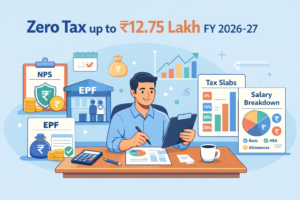
How ₹12.75 Lakh Salary Becomes Tax-Free
The most straightforward benefit comes from the standard deduction of ₹75,000, available to salaried individuals. This deduction directly reduces taxable income without requiring any investment or documentation.
For example, if your annual salary is ₹12.75 lakh:
- Standard deduction: ₹75,000
- Taxable income: ₹12 lakh
Since the taxable income falls within the rebate threshold, your total income tax liability becomes zero. This makes the new regime more attractive, especially for individuals who prefer simplified tax planning without multiple deductions.
Additionally, the increase in tax-free gift vouchers to ₹15,000 annually further enhances take-home benefits without increasing tax burden.
Can You Earn ₹14.80 Lakh and Still Pay Zero Tax?
Yes, the new tax regime calculation FY 2026-27 allows even higher salaries to become tax-free through smart salary structuring. With proper allocation of employer contributions and exemptions, taxable income can be reduced below ₹12 lakh.
Example Salary Structure
| Component | Amount (₹) | Details |
|---|---|---|
| Annual CTC | 14,80,000 | Total salary package |
| Basic Salary (50%) | 7,32,500 | Base component |
| Employer NPS (14%) | 1,02,550 | Tax-deductible |
| Employer EPF (12%) | 87,900 | Retirement benefit |
| Standard Deduction | 75,000 | Flat deduction |
| Gift Vouchers | 15,000 | Tax-free |
| Total Deductions | 2,80,450 | Combined benefits |
| Taxable Income | ~11,85,000 | Below ₹12 lakh |
This example clearly shows how individuals earning nearly ₹15 lakh can still avoid paying income tax legally.
Key Conditions to Achieve Zero Tax
This benefit is not automatic and depends heavily on how your salary is structured. To fully utilize the new tax regime calculation FY 2026-27, certain conditions must be met:
- Employer contributions to NPS and EPF must be included in your salary package
- Standard deduction must be applied
- Tax-free components like gift vouchers should be optimized
- Applicable only to salaried individuals with structured CTC
Without these elements, taxable income may exceed ₹12 lakh, resulting in tax liability.
Latest Income Tax Slabs FY 2026-27
There are no changes in income tax slabs 2026-27 under the new regime. The existing slab structure remains applicable:
| Income Range (₹) | Tax Rate |
|---|---|
| Up to 4 lakh | Nil |
| 4 lakh – 8 lakh | 5% |
| 8 lakh – 12 lakh | 10% |
| 12 lakh – 16 lakh | 15% |
| 16 lakh – 20 lakh | 20% |
| 20 lakh – 24 lakh | 25% |
| Above 24 lakh | 30% |
Despite unchanged income tax slabs 2026, the increased deductions and rebates significantly enhance tax-saving opportunities.
Why Salary Structuring Matters More Than Ever
The real advantage of the new tax regime calculation FY 2026-27 lies in intelligent salary design rather than high investment planning. Unlike the old regime, which relied heavily on deductions under Section 80C and others, the new regime simplifies tax planning while still offering strategic benefits.
Employer contributions to retirement funds not only reduce taxable income but also improve long-term financial security. Similarly, tax-free perks like gift vouchers add value without affecting tax liability.
The new tax regime calculation FY 2026-27 has redefined how salaried individuals can approach tax planning. With zero tax possible up to ₹12.75 lakh and even ₹14.80 lakh through structured salary components, the focus has shifted from heavy investments to smarter compensation design. Those who proactively align their salary structure with available exemptions and deductions can significantly enhance their take-home income while remaining fully compliant with tax laws.
 Receive our expert guide on ITR filing to understand complete process, eligibility, and key deadlines. Access step-by-step instructions to file income tax return accurately and maximize tax benefits – Click here