

The government has officially notified the Income Tax Return forms for ITR Filing AY 2026-27, bringing clarity on eligibility criteria, reporting requirements, and compliance expectations. Every taxpayer, whether an individual, business owner, or charitable entity, must select the correct ITR form to ensure accurate filing. The forms ranging from ITR-1 to ITR-7 cater to different categories of taxpayers, each with specific income sources and conditions.
Understanding the updated structure of ITR Filing AY 2026-27 is essential, as even a minor mistake in selecting the wrong form can result in defective returns or notices. The latest updates aim to simplify compliance while improving transparency through better disclosure requirements.
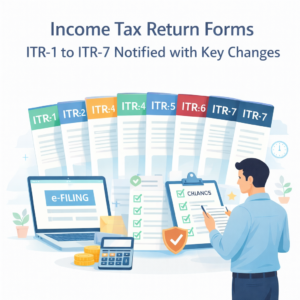
Overview of ITR Forms ITR-1 to ITR-7
The ITR Filing AY 2026-27 framework includes seven forms, each designed for a specific taxpayer category. ITR-1 (Sahaj) is meant for individuals with simple income structures, such as salary, one house property, and other income sources like interest, with total income up to ₹50 lakh. ITR-2 is applicable for individuals and Hindu Undivided Families (HUFs) who have income from capital gains or multiple properties but do not have business income.
ITR-3 is used by individuals and HUFs earning income from business or profession, including freelancers and traders. ITR-4 (Sugam) applies to small taxpayers opting for presumptive taxation schemes under Sections 44AD, 44ADA, or 44AE. Meanwhile, ITR-5 is meant for partnership firms, LLPs, and associations of persons, whereas ITR-6 is filed by companies other than those claiming exemption under Section 11.
ITR-7 is specifically designed for entities such as charitable trusts, political parties, and institutions claiming exemptions under the Income Tax Act. Choosing the correct form under ITR Filing AY 2026-27 is the first and most crucial step toward compliance.
Key Changes in ITR Filing AY 2026-27
The updated forms for ITR Filing AY 2026-27 reflect a continued focus on transparency and data matching. One of the notable changes is the enhanced disclosure of income sources, particularly for capital gains, foreign assets, and digital transactions. Tax authorities are increasingly relying on AIS (Annual Information Statement) and Form 26AS for cross-verification, making accurate reporting more critical than ever.
Another key update is the simplification of certain reporting fields to improve ease of filing for small taxpayers. At the same time, stricter validation checks have been introduced to minimize errors and ensure consistency in reporting. These changes indicate a shift toward technology-driven compliance, where mismatches can quickly trigger automated notices.
Eligibility Criteria: Selecting the Right ITR Form
Understanding eligibility is central to ITR Filing AY 2026-27, as each form has clearly defined criteria. For instance, individuals with income exceeding ₹50 lakh or having capital gains cannot use ITR-1 and must opt for ITR-2 or ITR-3. Similarly, taxpayers with business income must file ITR-3 or ITR-4, depending on whether they are under the presumptive taxation scheme.
Entities like trusts and NGOs must file ITR-7, provided they are claiming exemptions under relevant sections of the Income Tax Act. Filing the wrong form can result in the return being treated as defective, requiring correction within a limited time frame. Therefore, evaluating income sources and taxpayer category is essential before proceeding with filing.
Importance of Accurate ITR Filing and Compliance
Accurate ITR Filing AY 2026-27 is not just about meeting a legal requirement; it also ensures financial transparency and avoids future complications. With increased data integration across financial systems, discrepancies between reported income and official records can lead to scrutiny.
Taxpayers must ensure that all income sources, deductions, and tax credits are correctly reported. Proper documentation, reconciliation with AIS and Form 26AS, and timely filing play a critical role in avoiding penalties and notices. The emphasis on compliance highlights the importance of a disciplined approach to tax filing.
The notification of forms for ITR Filing AY 2026-27 marks the beginning of the compliance cycle for taxpayers across India. With clearly defined eligibility criteria and enhanced reporting requirements, selecting the correct ITR form is more important than ever. The updates reflect a balance between simplification for small taxpayers and stricter monitoring for accuracy.
By understanding the structure, changes, and eligibility rules, taxpayers can ensure smooth filing, minimize errors, and stay compliant with the Income Tax Act. A well-informed approach to filing not only prevents issues but also strengthens financial planning and record-keeping.
 Receive our expert guide on ITR filing to understand complete process, eligibility, and key deadlines. Access step-by-step instructions to file income tax return accurately and maximize tax benefits – Click here