

The concept of tax-free income for charitable and religious organizations is often misunderstood, especially when it comes to ITR-7 filing for trusts rules. While the Income Tax framework in India does provide exemptions, these benefits are far from automatic. Trusts, NGOs, and religious institutions must comply with a detailed set of legal and financial conditions to retain their tax-exempt status. The ITR-7 return is specifically designed for such entities, including charitable trusts, political parties, universities, and religious bodies that claim exemptions under various provisions of the Income Tax Act, 1961.
Under these rules, filing ITR-7 is not just a formality but a compliance mechanism that ensures transparency and accountability. Authorities evaluate whether the income generated by these entities is genuinely applied toward charitable or religious purposes. If there is any deviation, even partially, the exemption can be withdrawn. This strict regulatory framework has significantly changed how trusts manage their finances and reporting, making compliance a top priority rather than an optional process.
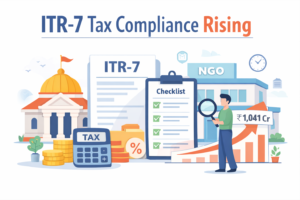
Rising Tax Liability: What the Latest ITR-7 Data Reveals
Recent government disclosures have highlighted a sharp increase in tax liability among entities filing under ITR-7. For FY 2025–26 (up to January 2026), the total tax liability has reached ₹1,041 crore, marking a record high. This is a substantial jump compared to ₹544 crore in FY 2016–17. During the pandemic years between 2019 and 2021, the figures temporarily declined to around ₹356–₹394 crore due to reduced donations and operational disruptions.
However, the post-pandemic recovery has led to a surge in financial activity, which is now clearly reflected in tax data. By FY 2023–24, the liability had already increased to ₹816 crore, indicating a steady upward trend. This rise is not merely due to higher income but also because of stricter enforcement of ITR-7 filing for trusts rules, where non-compliance directly translates into tax obligations.
Why Compliance Under ITR-7 Filing for Trusts Rules Is Becoming Stricter
The increasing ITR-7 Filing for Trusts Rules burden on charitable and religious institutions is largely driven by enhanced scrutiny and digitization. Tax authorities now rely heavily on data analytics and automated systems to identify discrepancies in filings. This means that even minor inconsistencies in reporting income or expenses can trigger detailed assessments. The enforcement of ITR-7 filing for trusts rules has become more rigorous, leaving little room for errors or misreporting.
Additionally, many trusts have diversified their income streams through commercial activities such as renting properties, organizing events, or receiving large donations. While these activities are not prohibited, they are subject to specific limits and conditions. Once these thresholds are crossed, the income becomes taxable. This shift toward financial expansion, combined with stricter monitoring, has contributed significantly to the rise in tax liability.
Key Conditions to Maintain Tax Exemption Status
To benefit from exemptions under the Income Tax Act, trusts must strictly adhere to certain conditions embedded within the ITR-7 filing for trusts rules. These include proper registration under relevant sections such as 12AB, maintaining audited financial records, and ensuring that at least 85% of income is applied toward charitable or religious objectives.
Another critical requirement is avoiding the misuse of funds for personal or unrelated commercial purposes. If authorities find that funds are diverted or not utilized as declared, the exemption is revoked. In such cases, the entire income may be taxed, often along with penalties. This makes compliance not just important but essential for the financial sustainability of these organizations.
GST Implications Alongside ITR-7 Filing
While income tax exemptions are governed by ITR-7, trusts must also consider Goods and Services Tax (GST) implications. Certain activities like religious ceremonies and distribution of prasadam are generally exempt. However, services such as renting halls, accommodation, or conducting paid events may attract GST if they exceed prescribed limits.
This dual compliance requirement means that trusts must align their operations with both income tax and GST regulations. Ignoring either aspect can lead to financial liabilities and legal complications. The integration of these tax systems reflects the government’s broader objective of ensuring accountability across all financial activities of charitable and religious entities.
The evolving landscape of ITR-7 filing for trusts rules clearly indicates that tax exemptions for religious and charitable entities in India are conditional and closely monitored. The rise in tax liability to ₹1,041 crore in FY 2025–26 demonstrates a significant shift toward stricter compliance and transparency. Trusts can no longer rely on the assumption of automatic tax-free status; instead, they must actively ensure adherence to all legal requirements.
As regulations continue to tighten, organizations that prioritize compliance will not only avoid tax liabilities but also build greater credibility and trust among stakeholders.
 Receive our expert guide on ITR filing to understand complete process, eligibility, and key deadlines. Access step-by-step instructions to file income tax return accurately and maximize tax benefits – Click here