

The announcement of the income tax slabs 2026 has generated significant attention among taxpayers across India. With the new Income Tax Rules 2026 coming into effect from April 1, many expected revisions in tax rates. However, the government has clarified that there is no change in income tax slabs 2026, keeping both old and new tax regimes intact. This means taxpayers can continue planning their finances based on the existing slab structure without worrying about sudden rate changes. The focus of the new rules is not on altering tax rates but on improving compliance, transparency, and digital tax administration.
This clarity is important because tax slab changes are typically introduced during the Union Budget. Since no such announcement was made in Budget 2026, the income tax slabs 2026 remain consistent with the previous year. For taxpayers, this ensures stability and predictability, allowing better financial planning without disruptions.
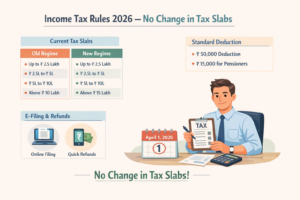
Income Tax Slabs 2026 Under Old and New Tax Regimes
Understanding the income tax slabs 2026 requires a comparison between the old and new tax regimes. Under the old tax regime, the structure continues to offer progressive tax rates starting with zero tax up to ₹2.5 lakh, followed by 5% up to ₹5 lakh, 20% up to ₹10 lakh, and 30% for income above ₹10 lakh. This regime remains beneficial for individuals who actively claim deductions such as HRA, Section 80C investments, and home loan benefits.
In contrast, the new tax regime under the income tax slabs 2026 offers a simplified structure with lower tax rates but minimal deductions. The tax rates start at zero up to ₹4 lakh, then gradually increase through multiple slabs, reaching 30% for income above ₹24 lakh. This regime is designed for individuals who prefer simplicity and do not rely heavily on tax-saving investments.
The choice between these two regimes depends largely on financial behavior. While the new regime offers convenience, the old regime can significantly reduce taxable income through deductions, making it more advantageous for disciplined investors.
Income Tax Slabs 2026: Standard Deduction and Key Reliefs
One of the important aspects of the income tax slabs 2026 is the standard deduction available to salaried individuals. Under the new tax regime, the standard deduction has been increased to ₹75,000, providing additional relief and reducing taxable income. Meanwhile, the old tax regime continues to offer a standard deduction of ₹50,000 along with various other exemptions.
This difference highlights the government’s approach of balancing simplicity with benefits. While the new regime provides a higher standard deduction, it eliminates most other deductions. On the other hand, the old regime allows multiple tax-saving options, which can lead to greater overall savings if utilized effectively. Taxpayers must carefully evaluate their salary structure, investments, and expenses before deciding which regime aligns better with their financial goals.
Income Tax Slabs 2026: What Has Changed If Rates Remain Same?
Even though the income tax slabs 2026 remain unchanged, several procedural and compliance-related updates have been introduced. The new Income Tax Rules 2026 emphasize digitisation, improved reporting standards, and streamlined processes. These changes aim to reduce disputes, enhance transparency, and ensure faster tax processing.
The introduction of a unified “tax year” concept simplifies the filing process by eliminating the distinction between previous year and assessment year. Additionally, extended deadlines for certain taxpayers and enhanced digital filing systems make compliance more efficient. These updates indicate that while tax rates remain stable, the overall tax ecosystem is evolving to become more structured and technology-driven.
Income Tax Slabs 2026: Who Should Pay Attention?
The income tax slabs 2026 are particularly important for salaried individuals, professionals, and business owners who need to plan their taxes effectively. Individuals earning above the exemption limits must carefully assess their tax liability under both regimes. In the new tax regime, individuals earning above ₹12 lakh (₹12.75 lakh for salaried individuals after standard deduction) will have a tax liability, while in the old regime, tax applies to income above ₹2.5 lakh.
This makes it essential for taxpayers to analyze their deductions, investments, and overall income structure. Choosing the right regime can significantly impact take-home income and long-term financial planning.
The Income tax slabs 2026 bring clarity and stability by maintaining existing tax rates while introducing important procedural improvements. Although there are no changes in tax slabs from April 1, 2026, the new rules focus on enhancing compliance, digitisation, and transparency. Taxpayers must now shift their focus from expecting rate changes to optimizing their tax strategy based on available deductions and financial behavior. Understanding the nuances of both tax regimes will be key to maximizing savings and ensuring efficient tax planning in the evolving tax environment.
 Receive our expert guide on ITR filing to understand the complete process, eligibility, and key deadlines. Access step-by-step instructions to file your income tax return accurately and maximize tax benefits – Click here