

Over the past few days, many taxpayers across India have reported receiving SMS and emails from the Income Tax Department stating that their income tax refund on hold. These messages mention that the return has been flagged under a risk management process due to discrepancies in refund claims. The sudden communication has created confusion and anxiety, especially among taxpayers who were expecting timely refunds.
The Income Tax Department has not issued a blanket clarification yet, but professionals explain that such messages are largely system-generated alerts and do not necessarily mean wrongdoing.
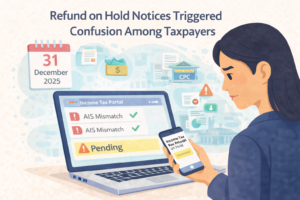
What Does the “Income Tax Refund On Hold ” Message Mean?
The message typically states that the processing of the income tax return (ITR) has been temporarily held due to certain mismatches or discrepancies identified during internal checks. These checks are part of the department’s risk management and verification framework.
In most cases, the department has also sent a detailed email to the taxpayer’s registered email address explaining the nature of the mismatch. The hold is usually preventive, allowing the department to verify refund claims before releasing the amount.
Why Are Income Tax Refund On Hold ?
Refunds are commonly put on hold when there is a mismatch between the information reported in the ITR and the data available with the Income Tax Department. This data is sourced from multiple reporting entities such as banks, employers, mutual funds, and other financial institutions.
Common triggers include mismatches in AIS (Annual Information Statement), Form 26AS, TDS credits, interest income, capital gains, or deductions claimed. Large refund amounts or unusual claims may also attract automated scrutiny.
Is This a Tax Notice or Enforcement Action?
Tax experts clarify that these Income Tax Refund On Hold messages are not enforcement notices and do not automatically lead to penalties or scrutiny proceedings. They are advisory in nature and are intended to alert taxpayers about possible inconsistencies.
The purpose is to give taxpayers an opportunity to voluntarily review, correct, or explain their filings before the department takes any further steps.
What Should Taxpayers Do After Receiving Income Tax Refund On Hold Messages?
The first step is not to panic. Taxpayers should log in to the Income Tax e-Filing Portal and carefully review their AIS and Form 26AS. Compare this data with the income and deductions reported in the ITR.
If discrepancies are found, taxpayers can provide feedback on the AIS through the online portal. In cases where genuine errors were made while filing the return, filing a revised ITR is usually the best solution.
Deadline to Take Corrective Action on Income Tax Refund On Hold
For Assessment Year 2025–26, the last date to file a revised or belated ITR is 31 December 2025. If corrections are made before this date, most refund-related issues can be resolved smoothly.
If the taxpayer fails to act within the deadline, options become limited, and refunds may get delayed further or require additional procedures such as rectification or updated returns.
The Income Tax Department increasingly relies on data analytics and automated risk filters to process millions of returns efficiently. These systems identify patterns that may indicate mismatches or incorrect claims.
Being flagged under risk management does not imply fraud. It simply means the return requires additional verification before refund issuance.
What Happens After the Issue Is Resolved?
Once discrepancies are clarified—either through AIS feedback, revised returns, or system verification—the refund processing usually resumes. The status on the portal changes accordingly, and the refund is credited along with applicable interest, if eligible.
Income Tax Refund On Hold messages are a wake-up call, not a warning notice. They highlight the importance of accurate reporting and timely review of tax filings. Taxpayers who respond promptly, verify their data, and take corrective steps before 31 December 2025 can avoid prolonged delays.
 Want to understand how to avoid refund delays in the future? Receive our expert guidance on accurate tax filing and faster refund processing – Click here.