

The HRA exemption rules are often misunderstood by taxpayers who assume that claiming House Rent Allowance automatically leads to high tax savings. However, the Income Tax Department has clarified that HRA exemption rules do not guarantee uniform benefits for everyone. The actual tax savings depend on multiple factors such as rent paid, salary structure, and city of residence.
Many salaried individuals include HRA in their tax planning but fail to understand how the HRA exemption rules work in practice. Think of it like a three-way filter—your final exemption is determined only after comparing specific conditions. This means even if you receive a high HRA, your tax benefit could still be limited depending on your circumstances.
Understanding these HRA exemption rules properly can help you make informed financial decisions and avoid overestimating your tax savings.
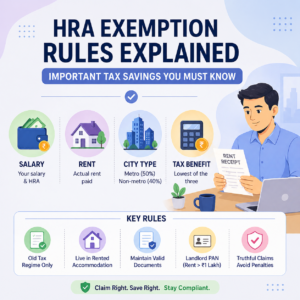
HRA Calculation Formula Under HRA Exemption Rules
The most important aspect of HRA exemption rules is the calculation method. The exemption is not a fixed amount but is determined as the lowest of three components:
- Actual HRA received from the employer
- 50% of basic salary for metro cities or 40% for non-metros
- Rent paid minus 10% of basic salary
Under the HRA exemption rules, whichever of these three values is the lowest becomes your eligible exemption. This calculation ensures that tax benefits are proportional to actual expenses and income levels.
For example, if you live in a metro city like Mumbai or Delhi, you may qualify for a higher percentage (50% of salary), but if your rent is low, your exemption will still be restricted. This is why simply receiving HRA does not guarantee high tax savings under the HRA exemption rules.
Eligibility Criteria for HRA Exemption Rules
To claim benefits under the HRA exemption rules, certain conditions must be met. These rules ensure that only genuine rental expenses qualify for tax exemption. The most critical requirement is that the individual must be living in a rented property and actually paying rent.
Another key aspect of HRA exemption rule is that the exemption is available only under the old tax regime. Taxpayers opting for the new regime cannot claim HRA benefits. Additionally, the person should not own the house they are currently residing in.
Interestingly, the HRA exemption rules allow some flexibility. If you own a property in another city but live in rented accommodation due to work, you can still claim HRA. Similarly, rent paid to parents is eligible, provided it is properly documented and declared as income by them.
Documents Required Under HRA Exemption Rules
Documentation plays a crucial role in complying with HRA rules. Taxpayers must maintain proper records to support their claims. Essential documents include rent receipts, rental agreements, Form 12BB, and salary slips showing HRA components.
One important requirement under the HRA exemption rules is providing the landlord’s PAN if the annual rent exceeds ₹1 lakh. This helps the tax authorities verify the authenticity of rental transactions and prevent misuse.
If the landlord does not have a PAN, taxpayers must submit a declaration with the landlord’s name and address. Proper documentation ensures that your HRA claim is accepted without complications.
Penalties for Misusing HRA Exemption Rules
Misreporting or misuse of HRA exemption rule can lead to serious consequences. Some taxpayers attempt to inflate rent or submit fake receipts to increase their tax savings. However, the Income Tax Department has strengthened verification mechanisms to detect such practices.
If your claim under the HRA exemption rules is found to be false, it can be disallowed during assessment, increasing your taxable income. Additionally, penalties under Section 270A can range from 50% to 200% of the tax payable on under-reported income.
The focus on stricter compliance highlights the importance of following HRA exemption rules honestly. Accurate reporting not only avoids penalties but also ensures smooth tax processing.
Why Understanding HRA Exemption Rules is Important
The HRA exemption rules are designed to provide relief to salaried individuals paying rent, but they require careful understanding and proper application. Blindly assuming high tax savings without calculating eligibility can lead to incorrect financial planning.
By understanding the HRA exemption rule, you can optimize your tax benefits while staying compliant with regulations. It also helps you avoid common mistakes such as over-claiming or missing required documentation.
In today’s data-driven tax environment, transparency is key. The better you understand the HRA exemption rule, the more effectively you can manage your tax liabilities.
The HRA exemption rule are not as straightforward as they may seem. While they offer valuable tax relief, the actual benefit depends on rent, salary, and city classification. By following the correct calculation method, maintaining proper documentation, and avoiding misreporting, taxpayers can fully utilize the benefits of HRA exemption rules without facing penalties.
 Want to understand how to avoid refund delays in the future? Receive our expert guidance on accurate tax filing and faster refund processing – Click here.