

The GST State Code List 2026 is an essential reference for businesses, accountants, and taxpayers registered under Goods and Services Tax in India. Every GST registration number (GSTIN) begins with a two-digit GST state code, which identifies the state or union territory where the business is registered.
Understanding the GST State Code List 2026 is important because these codes determine the place of supply, type of tax applicable (IGST or CGST + SGST), and GST compliance reporting. If an incorrect state code is used in invoices or returns, it can lead to tax calculation errors, Input Tax Credit (ITC) mismatches, and even e-invoice rejection.
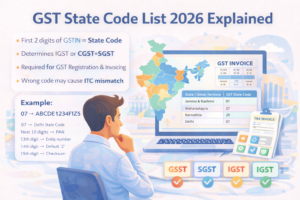
What is a GST State Code?
A GST State Code is a two-digit numeric code assigned to each Indian State and Union Territory under the GST system. These codes are based on the 2011 Census State Code framework and are used in GST registration, invoicing, and return filing.
The GST State Code List 2026 forms the first two digits of the GST Identification Number (GSTIN).
Example of GSTIN Structure
GSTIN: 07ABCDE1234F1Z5
-
07 – GST State Code (Delhi)
-
Next 10 digits – PAN of the taxpayer
-
13th digit – Entity number
-
14th digit – Default letter “Z”
-
15th digit – Checksum value
This structure ensures that every GSTIN uniquely identifies a taxpayer and their registered state.
Complete GST State Code List 2026
Below is the GST States Code List 2026 for all States and Union Territories in India.
| State / Union Territory | GST State Code |
|---|---|
| Jammu & Kashmir | 01 |
| Himachal Pradesh | 02 |
| Punjab | 03 |
| Chandigarh | 04 |
| Uttarakhand | 05 |
| Haryana | 06 |
| Delhi | 07 |
| Rajasthan | 08 |
| Uttar Pradesh | 09 |
| Bihar | 10 |
| Sikkim | 11 |
| Arunachal Pradesh | 12 |
| Nagaland | 13 |
| Manipur | 14 |
| Mizoram | 15 |
| Tripura | 16 |
| Meghalaya | 17 |
| Assam | 18 |
| West Bengal | 19 |
| Jharkhand | 20 |
| Odisha | 21 |
| Chhattisgarh | 22 |
| Madhya Pradesh | 23 |
| Gujarat | 24 |
| Dadra & Nagar Haveli and Daman & Diu | 26 |
| Maharashtra | 27 |
| Karnataka | 29 |
| Goa | 30 |
| Lakshadweep | 31 |
| Kerala | 32 |
| Tamil Nadu | 33 |
| Puducherry | 34 |
| Andaman & Nicobar Islands | 35 |
| Telangana | 36 |
| Andhra Pradesh | 37 |
| Ladakh | 38 |
| Other Territory | 97 |
| Other Country | 99 |
Note: Code 25 for Daman & Diu was discontinued after the 2020 merger.
Importance of GST State Code in GST Compliance
The GST States Code List plays a critical role in multiple GST compliance processes.
GST Registration
Every business must obtain separate GST registration in each state where it operates. The GSTIN issued contains the relevant GST state code, which identifies the state of registration.
For example, a company operating in Karnataka and Maharashtra will require two GST registrations.
GST Invoicing and E-Invoicing
The GST state code determines the place of supply and the type of tax charged.
-
Same state → CGST + SGST
-
Different states → IGST
If an incorrect GST state code is used in an invoice, it may result in:
-
Wrong tax calculation
-
ITC mismatch
-
IRN rejection in e-invoicing
GST Return Filing
During GSTR-1 and GSTR-3B filing, the GSTIN and its state code are used to report B2B transactions.
Incorrect GSTIN entries can lead to wrong ITC appearing in another taxpayer’s GSTR-2A or GSTR-2B, creating compliance issues.
GST Jurisdiction Under GST
Apart from the GST State Codes List 2026, every GST registration is also assigned a GST jurisdiction, which determines the tax authority responsible for the taxpayer.
There are two types of jurisdictions:
-
State Jurisdiction – Managed by the State GST department
-
Central Jurisdiction – Managed by the Central Board of Indirect Taxes and Customs (CBIC)
Based on CGST Circular 21/2017, taxpayers are divided between central and state authorities using a computerised allocation system.
For taxpayers with turnover up to ₹1.5 crore, about 90% are handled by state authorities and 10% by the central authority. For taxpayers with higher turnover, jurisdiction is generally shared equally.
The GST States Code List 2026 is a crucial element of the GST system that helps identify the state of registration, determine the place of supply, and ensure correct tax compliance. Businesses must use the correct GST state codes in registration, invoicing, and return filing to avoid tax errors, ITC mismatches, or compliance issues. Understanding the GST state codes structure also helps taxpayers maintain accurate GST records and ensure smooth GST reporting.
 Want to simplify your GST compliance and avoid refund delays? Explore our GST Registration & Compliance Services to stay audit-ready and penalty-free – Click Here