

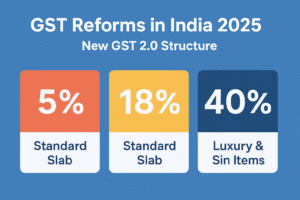
India is set to roll out GST Reforms in India 2025, marking a significant leap toward a simpler and more transparent tax system. The new GST 2.0 regime, effective from September 22, 2025, aims to streamline compliance, reduce tax rates on essentials, and boost consumption. This major policy shift, announced by the Prime Minister and approved during the 56th GST Council meeting, introduces only two standard slabs — 5% and 18% — along with a 40% rate for luxury and sin goods. The reform benefits households through cheaper daily goods, and supports MSMEs through automation, pre-filled returns, and faster refunds. Learn more on the official GST portal.
Impact of GST Reforms in India 2025 on Businesses and Consumers
The GST Reforms in India 2025 simplify the entire indirect tax landscape. Most goods taxed at 12% will now fall under 5%, while 90% of products from the 28% bracket will move to 18%. Essential categories like food, FMCG, insurance, healthcare, and education will see major cost reductions. For instance, life and health insurance become fully GST-exempt, and consumer products such as televisions, air conditioners, and vehicles shift to the 18% slab. On the other hand, luxury cars, tobacco, and online gaming now attract 40% GST. These changes are expected to boost affordability, encourage formalization, and reduce compliance costs for small businesses. For deeper insights, refer to CBIC’s official GST 2.0 update.
Sectoral Gains Under GST 2.0 and the Road Ahead
Under GST Reforms in India 2025, industries such as FMCG, automobiles, real estate, and healthcare stand to gain the most. Cheaper materials, reduced taxes, and automated compliance tools mean smoother business operations and stronger demand. Consumers benefit from lower prices on daily-use items like soaps, bicycles, and medical devices, while MSMEs enjoy simplified registration and pre-filled GST returns. The government’s goal with GST 2.0 is clear — make India’s tax regime simpler, fairer, and growth-driven. By March 2026, the compensation cess will be phased out, further easing the tax burden and marking the next chapter in India’s indirect tax evolution.
(Receive an Expert advice on GST Registration & GST return filing – Click here)
Frequently Asked Questions
1. What are the major GST Reforms in India 2025?
The GST Reforms in India 2025 introduce a simplified structure under GST 2.0, with two primary tax slabs — 5% and 18%, and a new 40% slab for luxury and sin goods. The reforms also include pre-filled GST returns, faster refunds, and exemption of health and life insurance from GST.
2. When will GST 2.0 come into effect?
The new GST 2.0 system will be implemented from September 22, 2025, following its approval at the 56th GST Council meeting held on September 3, 2025.
3. Which goods and services will become cheaper after GST Reforms in India 2025?
Daily essentials, FMCG products, electronics, small cars, clothing, insurance, healthcare, and educational materials will become cheaper under the new GST rates.
4. What is the new GST rate for luxury and sin goods?
Luxury and sin goods such as tobacco, pan masala, luxury cars, yachts, and online gaming will now attract a 40% GST rate under the new system.
5. How will GST Reforms in India 2025 benefit MSMEs and businesses?
The reforms aim to simplify compliance for MSMEs through automated filing, pre-filled returns, faster registration, and reduced inverted duty structures, leading to improved ease of doing business.
6. Will health and life insurance be taxed under GST 2.0?
No. Under GST Reforms in India 2025, health and life insurance are fully exempted (0%), making insurance more affordable and accessible to individuals.
7. What happens to the compensation cess after GST 2.0?
The compensation cess will be completely phased out by March 2026, marking a major step toward a unified and simplified GST regime.
8. Where can I find official updates about GST Reforms in India 2025?
You can visit the GST portal or the CBIC website for official circulars, notifications, and implementation details about GST 2.0.