

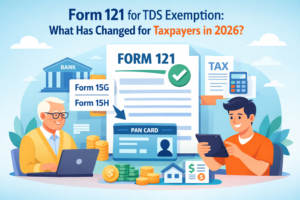
The introduction of Form 121 for TDS exemption under the Income Tax Act, 2026 marks a major shift in how taxpayers avoid unnecessary tax deductions. Earlier, individuals had to rely on Form 15G or Form 15H, depending on their age. This created confusion, especially for senior citizens who often struggled to determine which form applied to them. With the new system, Form 121 for TDS exemption replaces both forms, creating a single, unified declaration process that is easier to understand and implement.
At its core, Form 121 for TDS exemption is a self-declaration that allows taxpayers to confirm that their total income is below the taxable limit. Once submitted, it ensures that no TDS is deducted on eligible income sources such as interest, pension, or dividends. This change is particularly important because it reduces paperwork and improves compliance. The government’s focus is clearly on simplifying tax procedures while maintaining transparency, and Form 121 for TDS exemption plays a central role in achieving that balance.
Key Changes in Form 121 for TDS Exemption
The rollout of Form 121 for TDS exemption introduces several critical changes that directly impact taxpayers. One of the most important updates is the mandatory requirement of PAN. Without providing a valid PAN number, the declaration will be considered invalid, and TDS may be deducted at higher rates. This ensures that every taxpayer is properly identified, strengthening the overall tax system.
Another significant change is the introduction of a Unique Identification Number (UIN). Every submission of Form 121 for TDS exemption will be assigned a 26-digit UIN by the bank or financial institution. This number is then reported to the Income Tax Department, enabling real-time tracking and reducing the chances of tax evasion. The inclusion of UIN ensures that each declaration is verified and properly recorded, making the process more secure and reliable.
Banks also have an increased role in this system. They must complete Part B of Form 121 for TDS exemption and include these details in their TDS returns. This added layer of accountability ensures that all declarations are cross-verified, reducing errors and improving accuracy.
Unified System: Replacing Form 15G and 15H
The biggest advantage of Form 121 for TDS exemption is its ability to eliminate the need for multiple forms. Previously, individuals below 60 used Form 15G, while senior citizens relied on Form 15H. This dual system often caused confusion and led to incorrect submissions. Now, Form 121 for TDS exemption has replaced both forms, making the process straightforward for all taxpayers.
This unified approach benefits not only individuals but also financial institutions that process these forms. Instead of handling different formats and eligibility criteria, they now deal with a single standardized form. For taxpayers, this means fewer errors, faster processing, and better clarity. The simplification also encourages more people to submit declarations correctly, reducing unnecessary TDS deductions and improving cash flow.
Expanded Coverage Under Form 121 for TDS Exemption
Another major benefit of Form 121 for TDS exemption is its expanded scope. It now covers a wide range of income sources, making it a comprehensive solution for taxpayers. Whether you earn from bank deposits, pensions, or investments, Form 121 for TDS exemption ensures that you can declare all eligible income under one form.
The form applies to interest income, fixed deposits, pension payments, provident fund withdrawals, mutual fund earnings, dividends, insurance payouts, and even rental income. This broad coverage eliminates the need for multiple declarations and simplifies financial planning. For senior citizens, in particular, this is a significant advantage as they often rely on multiple income streams.
By consolidating everything into one document, Form 121 for TDS exemption reduces complexity and enhances convenience. Taxpayers can now manage their finances more efficiently without worrying about different rules for different income types.
Impact on Taxpayers and Senior Citizens
The introduction of Form 121 for TDS exemption has a direct and positive impact on taxpayers, especially senior citizens and pensioners. Earlier, managing tax declarations required understanding multiple forms and rules, which could be overwhelming. Now, with Form 121 for TDS exemption, the process is much simpler and more user-friendly.
Senior citizens benefit the most because they no longer need to switch between forms based on age criteria. A single declaration covers all their needs, reducing both effort and confusion. The mandatory PAN requirement and UIN tracking also provide greater transparency, ensuring that their submissions are accurately recorded.
For the broader taxpayer base, Form 121 for TDS exemption improves efficiency and reduces the risk of errors. It ensures that individuals who are not liable to pay tax are not subjected to unnecessary deductions, thereby improving cash flow and financial stability.
The launch of Form 121 for TDS exemption under the Income Tax Act, 2026 represents a significant step toward simplifying India’s tax system. By replacing Forms 15G and 15H, introducing PAN-based validation, and implementing UIN tracking, the government has created a more transparent and efficient framework. Form 121 for TDS exemption not only reduces paperwork but also ensures better compliance and accountability. For taxpayers, especially senior citizens, this change translates into convenience, clarity, and improved financial management.
 Want to understand how to avoid refund delays in the future? Receive our expert guidance on accurate tax filing and faster refund processing – Click here.