

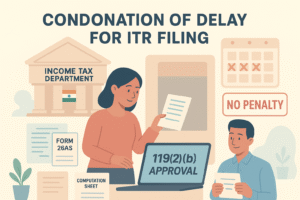
The Condonation of Delay for ITR Filing is a crucial relief mechanism offered by the Income Tax Department for taxpayers who miss their income tax return deadlines due to genuine hardship. As per the Income Tax Act, returns must be filed under Section 139(1) (original return) or Section 139(4) (belated return). However, unexpected circumstances such as medical emergencies, technical failures, family emergencies, or delays in receiving necessary documents often prevent timely filing. In such scenarios, Section 119(2)(b) allows taxpayers to seek relief through a condonation request, enabling them to file their return without penalties or additional tax.
Why Condonation of Delay Is an Important Tax Relief
The Condonation of Delay for ITR Filing provides exceptional relief because it allows taxpayers to file their return after the due date without paying late fees or penalties. Once the Principal Commissioner of Income Tax (PCIT) accepts the request, taxpayers can file the return under Section 139(9A) using the approval order. This helps avoid the heavy additional taxes associated with filing an ITR-U under Section 139(8A), which may range from 25% to 70% depending on the assessment year. By enabling taxpayers to avoid these steep charges, condonation becomes a valuable option for anyone who missed the deadline due to valid reasons.
How to File a Condonation Request (Step-by-Step)
The option for online filing of a condonation request is not yet available on the e-filing portal. Therefore, taxpayers must follow the manual process by submitting an application to their jurisdictional PCIT.
To file your Condonation of Delay for ITR Filing, include:
-
A detailed explanation of the genuine hardship
-
Revised computation of income
-
Reconciliation statement of Form 26AS (if applicable)
-
Proof of deductions or expenses claimed in the revised ITR
-
Relevant supporting documents such as medical certificates, employer letters, or technical issue screenshots
Once the PCIT approves the request, a unique condonation order number is issued. This number must be used when filing the revised ITR under Section 139(9A). A well-supported application increases the chances of approval since the relief is discretionary and depends heavily on proving genuine hardship.
Refunds, Loss Benefits & Why Condonation Matters
The Condonation of Delay for ITR Filing is not limited to late filing—it can also be used for claiming refunds, carrying forward losses, setting off losses, or correcting errors in the original return. Even if a taxpayer misses the statutory deadlines, refunds can still be issued if the tax authorities are convinced of the genuine reason for delay.
-
Late fees under Section 234F
-
Interest liabilities under Sections 234A, 234B, and 234C
-
Additional tax burden under Section 139(8A)
-
Loss of refunds and carry-forward benefits
Overall, Condonation of Delay for ITR Filing provides essential protection for honest taxpayers who could not file on time due to circumstances beyond their control. Since the process is currently offline and proper documentation are key to ensuring approval.
👉 Want to know which strategy works best for your income bracket? Receive our expert advice on Smart Ways to Save Tax – Click here