

As Budget 2026 approaches, taxpayers, professionals, and businesses are closely watching proposed Budget 2026 income tax amendments. However, unlike previous years, the upcoming budget presents a unique legislative situation. Any income tax changes announced in Budget 2026 will not amend the familiar Income Tax Act, 1961. Instead, all Budget 2026 income tax amendments will be incorporated directly into the Income Tax Act, 2025, which has already been enacted but is yet to be enforced.
This transition marks a significant shift in India’s tax framework and has important implications for taxpayers.
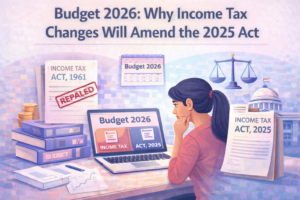
Why Budget 2026 Income Tax Amendments Cannot Target the 1961 Act
The Income Tax Act, 1961 is scheduled to be repealed with effect from 1 April 2026. Since the Finance Bill, 2026 will be presented just before this repeal, it would be legally illogical to introduce Budget 2026 income tax amendments into a law that is about to cease to exist.
Legislative practice requires that amendments must be made to a law that will remain in force. As the Income Tax Act, 2025 already exists on the statute book and awaits enforcement, all Budget 2026 income tax amendments—whether related to tax slabs, exemptions, compliance rules, or relief measures—will necessarily be routed through the 2025 Act.
Income Tax Act, 2025: The New Home for Budget 2026 Amendments
The Income Tax Act, 2025 represents a structural reorganization of India’s income tax laws. While the substance of taxation remains largely familiar, the framework has been simplified, consolidated, and modernized.
As a result, Budget 2026 income tax amendments will likely focus on refining this new structure rather than rewriting old provisions. Any changes to personal income tax, salary exemptions, deductions, or reporting obligations will be implemented directly within the 2025 Act to ensure a seamless transition for taxpayers.
Budget 2026 Income Tax Amendments and Salary Income Provisions
One of the most significant areas affected by Budget 2026 income tax amendments is salary income. Under the Income Tax Act, 1961, salary-related exemptions and deductions were scattered across multiple sections, including Sections 10, 16, and 17.
The Income Tax Act, 2025 consolidates these provisions into Section 19, supported by structured schedules. Exemptions such as standard deduction, gratuity, leave encashment, commuted pension, voluntary retirement benefits, and retrenchment compensation now appear in a unified format.
If Budget 2026 proposes changes to these reliefs—such as higher exemption limits or revised conditions—those Budget 2026 income tax amendments will directly modify Section 19 or the related schedules of the 2025 Act.
Shift to Schedule-Based Exemptions
Another notable change relevant to Budget 2026 income tax amendments is the move toward schedule-based exemptions. Popular benefits like House Rent Allowance (HRA), Leave Travel Allowance (LTA), and special allowances are now listed in Schedule III of the 2025 Act.
While the substantive relief continues, the government has greater flexibility to modify rules and thresholds through delegated legislation. This means Budget 2026 income tax amendments can adjust exemption mechanics without rewriting the core statute, offering both adaptability and administrative efficiency.
What Taxpayers Should Expect from Budget 2026 Income Tax Amendments
Taxpayers can expect Budget 2026 income tax amendments to focus on:
-
Rationalisation of personal income tax slabs
-
Alignment of exemptions with inflation trends
-
Simplification of compliance under the new tax regime
-
Clarity in transition provisions from the 1961 Act to the 2025 Act
However, any relief measures will be weighed against fiscal discipline and revenue considerations.
In summary, Budget 2026 income tax amendments will mark the first major refinement of the Income Tax Act, 2025. Since the 1961 Act is being repealed, all tax policy changes announced in Budget 2026 must logically and legally be embedded in the new law. For taxpayers, this means adapting not just to new rates or exemptions, but to an entirely new legislative framework governing income taxation in India.
As Budget 2026 unfolds, understanding these Budget 2026 income tax amendments will be critical for effective tax planning and compliance in the years ahead.
 Want to understand how to avoid refund delays in the future? Receive our expert guidance on accurate tax filing and faster refund processing – Click here.