

The Central Board of Direct Taxes (CBDT) has issued the latest ITR Scrutiny Guidelines FY 2026-27, outlining the categories of taxpayers whose Income Tax Returns (ITRs) may be selected for compulsory scrutiny. These guidelines are important for individuals, professionals, businesses, and companies filing returns during FY 2025-26 and Assessment Year 2026-27.
The new ITR Scrutiny Guidelines FY 2026-27 aim to strengthen tax compliance, improve transparency, and identify cases involving significant tax risks. Under these guidelines, the Income Tax Department can conduct detailed examinations of selected returns to verify the accuracy of income disclosures, deductions, exemptions, and tax payments.
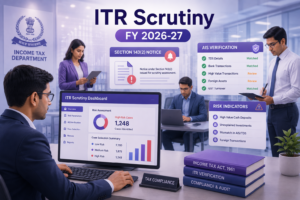
What Are ITR Scrutiny Guidelines FY 2026-27?
The ITR Scrutiny Guidelines FY 2026-27 provide a framework for selecting specific income tax returns for detailed assessment. Scrutiny assessment is a process through which the Income Tax Department examines the information provided by taxpayers and compares it with available records, financial transactions, and third-party data.
The CBDT has clarified that returns falling under specified risk categories will be selected for compulsory scrutiny irrespective of regular risk-based selection methods. The objective of the ITR Scrutiny Guidelines FY 2026-27 is to detect tax evasion, ensure correct reporting of income, and verify high-risk transactions.
Taxpayers Who May Face Compulsory Scrutiny
According to the ITR Scrutiny Guidelines FY 2026-27, certain categories of taxpayers are more likely to receive scrutiny notices.
One of the primary categories includes taxpayers subjected to surveys under Section 133A of the Income Tax Act. If a survey has been conducted on or after April 1, 2024, the related return may automatically qualify for compulsory scrutiny. Cases involving significant discrepancies identified through data analytics, information received from government agencies, enforcement authorities, regulatory bodies, or international tax information exchanges may also be selected.
The ITR Scrutiny Guidelines FY 2026-27 further emphasize scrutiny of cases involving suspicious financial transactions, unexplained investments, incorrect deductions, or inconsistencies between filed returns and available information.
Role of Section 143(2) Notices
A scrutiny assessment generally begins with the issuance of a notice under Section 143(2) of the Income Tax Act. This notice informs taxpayers that their return has been selected for detailed examination.
Under the latest ITR Scrutiny Guidelines FY 2026-27, the Income Tax Department must follow prescribed timelines and procedures before initiating scrutiny proceedings. Taxpayers receiving a Section 143(2) notice must provide supporting documents, explanations, and evidence to substantiate the claims made in their income tax returns.
Common Reasons for Scrutiny Selection
The ITR Scrutiny Guidelines FY 2026-27 highlight several factors that may increase the likelihood of scrutiny. Large cash deposits, high-value property purchases, substantial capital gains, foreign assets, overseas transactions, and unusual deductions often attract attention from tax authorities.
Mismatch between Form 26AS, AIS, TDS details, GST returns, and reported income may also trigger scrutiny. Businesses and professionals should ensure consistency across all financial records and tax filings. Additionally, repeated reporting errors, unexplained losses, and significant variations in income patterns may increase scrutiny risk under the ITR Scrutiny Guidelines FY 2026-27.
How Taxpayers Can Reduce Scrutiny Risk
Taxpayers should maintain accurate records and ensure complete disclosure of income from all sources. Cross-verifying information available in Form 16, Form 26AS, AIS, bank statements, and investment reports is essential. Proper reporting of capital gains, interest income, rental income, foreign assets, and business receipts can significantly reduce the chances of receiving a scrutiny notice.
The ITR Scrutiny Guidelines FY 2026-27 also highlight the importance of timely compliance and accurate documentation. Supporting records should be preserved for future verification whenever required.
The newly issued ITR Scrutiny Guidelines FY 2026-27 indicate that the Income Tax Department is increasingly relying on data analytics, information sharing, and risk assessment systems to identify high-risk returns. Taxpayers should focus on accurate reporting, proper documentation, and reconciliation of financial information before filing their returns. Understanding the ITR Scrutiny Guidelines FY 2026-27 can help taxpayers stay compliant, avoid unnecessary notices, and ensure a smoother tax filing experience during the current assessment year.
 Receive our expert guide on ITR filing to understand the complete process, eligibility, and key deadlines. Access step-by-step instructions to file your income tax return accurately and maximize tax benefits – Click here